Top 10 Street Skateboarding Tricks Every Skater Should Master
Street skateboarding in Santa Cruz hits different.
From crusty downtown spots to classic NorCal ledges, Santa Cruz street skateboarding is where creativity meets concrete.
No rules. Just raw terrain, style, and progression shaped by decades of West Coast influence. This is a city where skateboarding isn't a trend — it's life.
Whether you're skating local streets or filming clips along the coast, these are the essential street skateboarding tricks every skater should master. These aren't just random tricks thrown into a list.
They're foundational movements that build control, confidence, and real street credibility.
Master these, and you're not just learning tricks — you're building real style.
1. Ollie (The Foundation of Street Skateboarding)
Everything in street skating starts with the ollie.
Without a solid ollie, street progression stops before it even begins. The ollie is what transforms a skateboard from something you roll on into something you control in the air.
The ollie allows you to:
- Clear stairs
- Get onto ledges
- Lock into grinds
- Set up flip tricks
- Gap cracks and rough pavement
On rough ground, especially in California, your ollie needs to be controlled — not just high. The terrain isn't always forgiving. Clean technique matters.
A strong ollie teaches:
- Timing
- Foot placement
- Board leveling
- Impact control
Pro Insight: Focus on leveling the board mid-air. Clean, controlled ollies matter more than high, sloppy ones — especially when skating real street spots.
When your ollie feels effortless, everything else becomes possible.
2. Frontside & Backside 180
Once your ollie is locked, the next progression is rotation.
Frontside and backside 180s build board control and body awareness. They teach you how to rotate with the board rather than fight it.
These tricks help you:
- Approach obstacles from different angles
- Build confidence at higher speeds
- Develop switch skills over time
Rotation tricks are essential in street lines. They connect obstacles and help you maintain flow.
The key to clean 180s is shoulder alignment. Where your shoulders lead, your board follows.
As you improve, you'll start using 180s not just as standalone tricks, but as setup tools — landing fakie, rolling into manuals, or lining up for ledge tricks.
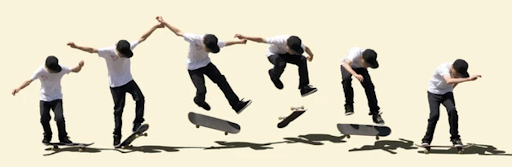
3. Kickflip
The kickflip is the most iconic street skateboarding trick.
It changed street skating forever. When flip tricks started being taken down stair sets in the 90s, technical skating entered a new era — something deeply connected to California skate culture.
The kickflip is:
- The backbone of technical skating
- A gateway to advanced flip variations
- A test of timing and consistency
Landing your first kickflip clean on concrete feels like unlocking a new level.
But consistency is what separates beginners from real street skaters.
Pro Insight: Flick out, not down. A clean outward flick creates better rotation and keeps the board underneath you.
Once you can kickflip consistently, your trick vocabulary expands dramatically.
4. Heelflip
Many skaters favor kickflips early on, but heelflips bring versatility and control. They challenge your balance differently and force you to adjust your stance and flick mechanics.
Why it matters:
- Expands trick combinations
- Strengthens overall flick control
- Improves balance
Heelflips often feel awkward at first. But once unlocked, they add depth to your lines.
Skaters who can kickflip and heelflip confidently gain freedom. They're no longer limited to one direction of flick. That freedom is key in street skating.
5. Pop Shove-It
The pop shove-it looks simple — but it builds serious board awareness.
This trick teaches:
- Scoop control
- Rotational timing
- Foot repositioning mid-air
- Confidence landing blind
Pop shove-its are perfect for:
- Flatground lines
- Ledges
- Combo tricks
Clean pop shove-its look effortless. Sloppy ones look rushed.
The secret is the scoop. A tight, controlled scoop keeps the board spinning under you instead of drifting away.
Once mastered, shove-its become building blocks for bigger tricks like tre flips.
6. Boardslide (First Real Street Obstacle Trick)
Boardslides are where street skating starts feeling real.
Sliding metal or concrete changes your relationship with fear. You're no longer just flipping your board — you're committing your body to an obstacle.
Boardslides teach:
- Commitment
- Rail balance
- Approach speed control
- Exit timing
The first boardslide is mental more than physical.
Start on low ledges before moving to rails. Learn how your trucks feel locking into position. Boardslides build trust between you and your board.
7. 50-50 Grind
The 50-50 is the backbone of ledge skating.
Both trucks locked on the obstacle. Balanced. Controlled. Clean.
It helps you:
- Learn grind balance
- Distribute weight evenly
- Adjust to different ledge heights
- Build confidence for advanced grinds
50-50s are foundational because they introduce true grind mechanics. Once comfortable, you'll naturally progress into variations.
Mastering 50-50s builds serious street credibility — especially on real street ledges, not just skatepark boxes.
8. Crooked Grind
Crooked grinds separate intermediate skaters from advanced ones.
Locking your front truck while keeping your back truck lifted requires precision. Crooks demand accuracy and balance.
Why it matters:
- Teaches front truck control
- Improves weight distribution
- Strengthens ledge & rail confidence
- Looks clean in technical lines
Crooks are staples in modern street skating. They flow well into flip-out combinations and feel smooth when done right.
The key is approach angle. Come in too straight and you'll 50-50. Too angled and you'll miss the lock.
Precision builds progression.
9. Tre Flip (360 Flip)
The tre flip combines a pop shove-it with a kickflip — pure street energy.
It's:
- A benchmark trick
- A test of timing
- A control challenge
Tre flips require strong scoop mechanics and consistent flick. The board spins 360 degrees while flipping — and your job is to stay centered above it.
Landing a clean tre flip in a line hits different. It shows control, commitment, and confidence.
Once tre flips feel natural, your technical skating reaches another level.
10. Manual (And Nose Manual)
Manuals aren't flashy — but they define style.
Street skating isn't just about landing one trick and rolling away. It's about flow.
Manuals teach:
- Balance control
- Line construction
- Speed awareness
- Creativity
Manuals connect tricks together.
Ollie into manual. 180 out. Kickflip into nose manual. Shove-it out.
That's where real street style develops.
Flatground balance might not look extreme, but it separates robotic skating from fluid skating.
Why This Matters for Skateboarders
Skateboarding has deep skate roots. From influential brands to gritty street spots, the culture values progression, authenticity, and raw style.
Skateboarding in Santa Cruz isn't about chasing trends. It's about putting in work on real terrain.
Mastering these tricks gives you:
- Confidence
- Control on stairs and ledges
- Technical consistency
These ten tricks form the foundation of real street skating.
They connect creativity with control.
If you're building your street skating skills, mastering these tricks prepares you to skate anywhere — downtown streets, coastal gaps, parking lots, or crusty ledges.
And if you're riding for a local brand like Paint The World, progression isn't optional — it's part of skateboarding.
Because at the core of street skating, especially in Santa Cruz, it's simple:
Concrete. Commitment. Control.

Written by Sage Stewart

Leave a comment
This site is protected by hCaptcha and the hCaptcha Privacy Policy and Terms of Service apply.